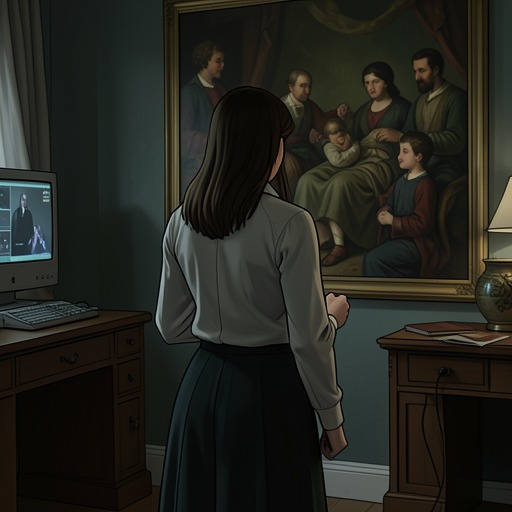
Marion Longwood
The Werewolf Mates Anthology (Erotic Romance)Marion Longwood is the ruling matriarch of the Longwood family and the mother of Wren Longwood. Her decisive appearance in the story comes when she travels to Wren’s Boise apartment to demand that her daughter return to the family. What first presents itself as a controlled family intervention becomes an ultimatum: Marion treats Wren’s werewolf condition as a problem to be managed, a possible research resource, and finally grounds for permanent exclusion. Through her, family prestige and professional authority become inseparable from the policing of Wren’s body and identity.
Identity and Family Authority
Marion is introduced sitting primly on Wren’s couch and typing on a tablet computer, an image of composure that makes her uninvited presence feel even more invasive. Wren does not know how Marion entered the apartment and expects that any question about it would receive only an enigmatic assurance that she has her ways. Marion’s control therefore appears not merely as a matter of what she says, but as an atmosphere surrounding her: she enters where she has not been invited, occupies the central room, and waits for Wren to confront her.
Physically, Marion is described as sixty years old while carefully maintaining the appearance of a woman no older than forty-seven. Her long dark brown hair, pale skin, expertly applied makeup, and insistence on concealing every imperfection construct an image of disciplined refinement. Wren and Marion visibly share blood, but the resemblance does not produce warmth. Instead, their shared appearance underscores the family system Marion embodies: inheritance is evident, while affection has become conditional.
Marion rules the Longwood family with an iron fist. Until only a few months before the confrontation, Wren both feared and respected her as a mother and almost godlike authority. That earlier reverence has collapsed by the time Marion arrives in Boise. Wren now sees her as someone not worth her time, yet the force of thirty-three years of conditioning still makes it difficult to resist Marion’s commands. The scene thus presents maternal authority as something learned so deeply that even rejection does not immediately erase its power.
The Visit to Wren’s Apartment
Marion declares that it is time for Wren to come home, presenting the decision as an order rather than an invitation. Her unusually personal intervention signals that the family considers Wren’s condition serious. The Longwoods have already responded to Wren’s transformation with fear and distance, despite the fact that the first three weeks after her illness had seemed normal: her family was sympathetic, and no one yet understood what was coming. The later revelation of her enhanced running speed, vision, and hearing, followed by the arrival of the full moon, turns that initial sympathy into institutional concern.
Marion explains that the family has researched Wren’s condition and concluded that she will not be as harmful as they had feared. The wording reduces Wren to a risk assessment. The family has also devised a way to manage her monthly episodes and arranged a place for her at its headquarters. When Wren objects that she hates corporate law, Marion clarifies that Wren will not return to the legal department. Instead, she will work in the family’s research operation, where Marion says she will be incredibly helpful.
The apparent offer of employment is therefore a disguised form of custody and experimentation. Marion does not frame Wren as a professional being asked to choose a career, but as a transformed body whose usefulness can be extracted by the family. Wren immediately recognizes the implication: her mother wants to use her as a laboratory rat. The family’s concern for managing monthly outbursts is inseparable from its desire to study or exploit the condition that has made Wren unacceptable within the family home.
Wren rejects the arrangement outright. She tells Marion that she will not go to New York, asks her to stop calling, and orders her never to return. Marion remains seated and simply looks at her, reducing Wren’s defiance to a momentary disturbance. The silent response is more coercive than an argument because it restores the old hierarchy: Wren may speak, but Marion assumes the power to decide what her words mean.
Expulsion and the Meaning of Home
Marion’s counteroffer is not negotiation but conditional belonging. If Wren does not come home immediately, Marion says, she will never be invited back. The threat strikes at Wren’s lingering hope that she might someday be welcomed for herself, even if only as a visitor. The pain is severe, but it arrives with a measure of recognition: Wren understands that the family’s acceptance was never as secure or unconditional as she had wanted to believe.
Marion then makes the exclusion permanent and unmistakable. She calls Wren a disappointment, tells her not to call, and warns that the police will be summoned if she attempts to enter any Longwood property. The family home is converted into protected territory, and the daughter is recast as a trespasser. Marion leaves with her briefcase without looking back, preserving her composure while Wren collapses onto the couch and lets misery engulf her.
The contrast between the two women gives the expulsion its force. Marion departs upright, equipped, and socially authorized; Wren remains physically overwhelmed and emotionally abandoned. Yet the scene also marks a reversal. Marion can terminate Wren’s place within the Longwood family, but she cannot compel Wren to accept the family’s definition of her condition. Wren’s refusal is the first clear act of choosing her own life over the inherited structure that once governed her.
Conflict with Wren’s New Attachments
Wren’s rejection of Marion does not leave her isolated. Andy Olson comes to her afterward, and his response exposes the moral difference between the two relationships. Rage surges through Andy when he understands that Marion wanted Wren returned for research, and he wants to hunt her mother down and destroy her for considering it. Wren tells him that she ordered Marion to leave and never come back. Andy does not press Wren to stay with him, but kisses her forehead, holds her, and offers help without dictating what she must do. Wren thanks him, and they remain entwined on the couch until she falls asleep against his shoulder; he carries her to bed and sleeps beside her.
That care provides an immediate counterpoint to Marion’s conditional command. Marion defines kinship through obedience, property, and usefulness. Andy offers presence without requiring Wren to surrender her agency. The difference helps explain why Wren’s expulsion, although devastating, also creates the possibility of a chosen home outside Manhattan and the Longwood family.
Marion’s authority also belongs to a wider network of competing institutions. Wren had already rejected the corporate legal path her mother had imposed on her, choosing instead to practice criminal law in Boise. Elsewhere in the story, lawyers, prosecutors, the werewolf pack, and Silver Sky Research each operate according to different rules about responsibility, secrecy, control, and bodily status. Marion’s proposal resembles Silver Sky’s unauthorized human experimentation in its treatment of a person as a useful subject, even though Marion presents the arrangement as family management rather than criminal abuse. Against both systems, Wren’s refusal insists that transformation does not cancel consent.
Narrative Significance
Marion is important less for the amount of time she spends on the page than for the structure of power she makes visible. Her polished body, formal speech, and command of family resources conceal no uncertainty about hierarchy. She speaks for the Longwoods, classifies Wren’s condition, assigns its proper institutional response, and determines the terms on which Wren may remain a daughter. Her authority is simultaneously maternal, familial, economic, and quasi-professional.
The character also crystallizes the story’s contrast between inherited membership and chosen affiliation. The Longwood family has existed in Manhattan for more than two hundred years, but its longevity offers Wren no protection once she becomes a werewolf. A family that can carry blood across generations refuses to carry the transformed daughter within its boundaries. Marion’s final prohibition makes the contradiction literal: blood relation remains, while home is revoked.
Marion therefore functions as the agent of Wren’s formal expulsion and as the figure against whom Wren’s later attachments gain definition. Her demand that Wren return, her plan to place Wren in research, and her threat to involve the police all fail to restore obedience. Instead, they sever the old bond and clarify the cost of belonging to the Longwoods. Marion leaves Wren in misery, but the refusal that precipitates that misery becomes the foundation of Wren’s independence.